Tuesday, March 20, 2018

Mixed Up Lines

A few years ago, when my daughter came home from school, she stormed over to me and said, “I am so angry with you!” This didn’t happen often, so I was concerned. “You have ruined me!” she told me.

She explained that in class someone had said, “You can lead a horse to water…” and my daughter had added, “but you can’t make it swim.” The room broke out in laughter and she didn’t understand why.

I did. You probably do. I understood why she was upset with me.  Oops.

Similarly, if I accidentally rhyme in class, I say that “I’m a poet and I’m not consciously aware of that fact.” This wouldn’t get my daughter in trouble – I think.

I love to play with words, phrases, letters, and language. I don’t say the proverb the regular way; I mess around with it. I can’t remember the last time I talked about that horse drinking. My daughter had only heard my riff on the original. Now she knows.

I am constantly mixing up language in class. My speech is peppered with spoonerisms. Spoonerisms are the mixing up of the initial constant sounds of a phrase or sentence. My students know exactly what I want them to do if I tell them to go sack to your beats. Taking a cue from the wonderful lirty dies of Capitol Steps, I often address them as Jadies and Lentleman. My Freshman English students play the Punday Suzzle, and homeroom says the ledge of pallegiance every day. 

One year, my Senior English class surprised me with a special gift at the end of the year. It was a long, large, and flat wrapped package. When I opened it, I couldn’t contain my laughter. It was a pair of pruning cutters. Yes, it was a gift of shears. "Gifting shears" is my frequent transition statement – another spoonerism.

Of course, I love puns! I tell kids that I am very impatient: I have a wait problem. I encourage them to imitate Shakespeare and punish each other by being bad to the bard. As we open our computers (or notebooks) to journal or start an essay, I tell students to “do the write thing!” If they don’t start fast enough, I tell them to “write away” or to do it “write now!” Yes, sometimes my puns get a groan. That is second place to a laugh, but I’ll take it.

Of course, there are always students who finish the writing too quickly. They set aside their pens or machines and look at me and say that they are done. I shake my head and tell them that they are still rare, maybe medium rare or medium, but they are certainly not done, and I want their work to be well done!

Then one will ask if it is okay that they finish anyway. I have perfected the art of saying “no” but shaking my head up and down. As you would expect, this is confusing. My non-verbal communication is saying one thing and my voice is saying the opposite. “Which is it?” They ask. Yes, that is the question.

When discussing certain literary elements, I always pretend that I am the percussionist at the back of the band and have crashed my two big pieces of metal together.  When we start to decode those eyes in Gatsby or the sea in A Tale of Two Cities, students also get the pun cymbal and symbol.

My former student Aaron (and several others) reminded me that, when I would check for understanding, I would ask in my very very bad Italian: “Catfish?” Similarly, Lucas reminded me that my French is as poor as my Italian. While we may say, “please” in English, I frequently thank students with “mercy buckets.”

-->
Language is not static. I encourage kids to play with language. As we write and speak, we must think about not just what we are saying, but the words we use. Language forms the foundation of our thought. Changing our words can change our perception. Language matters. Words matters. I hope my mixed up word playfulness gives kids permission to play along!  

Saturday, March 10, 2018

Van...Gone


I was relieved and embarrassed when I confessed to some friends that I felt very sad when I sold my minivan. It is a thing, not a person. Why would I get choked up when I turned over the keys, took off the license plates, and created an open spot in the driveway? I have never been bothered by getting rid of a vehicle before.

The van’s presence on the driveway was a sign of the development of our family. As my kids went to college and left the house, the van represented a time when we were together more often. We were busy, and we were all in that van.

I was also relieved because several friends said that they, too, grieved when they ended their relationships with their vans. Their vans represented the same things to them. They had shuttled their kids, took road trips, and journeyed to summer camps. For many of us, our vans were as old or older than our children. We had all grown up in the van!

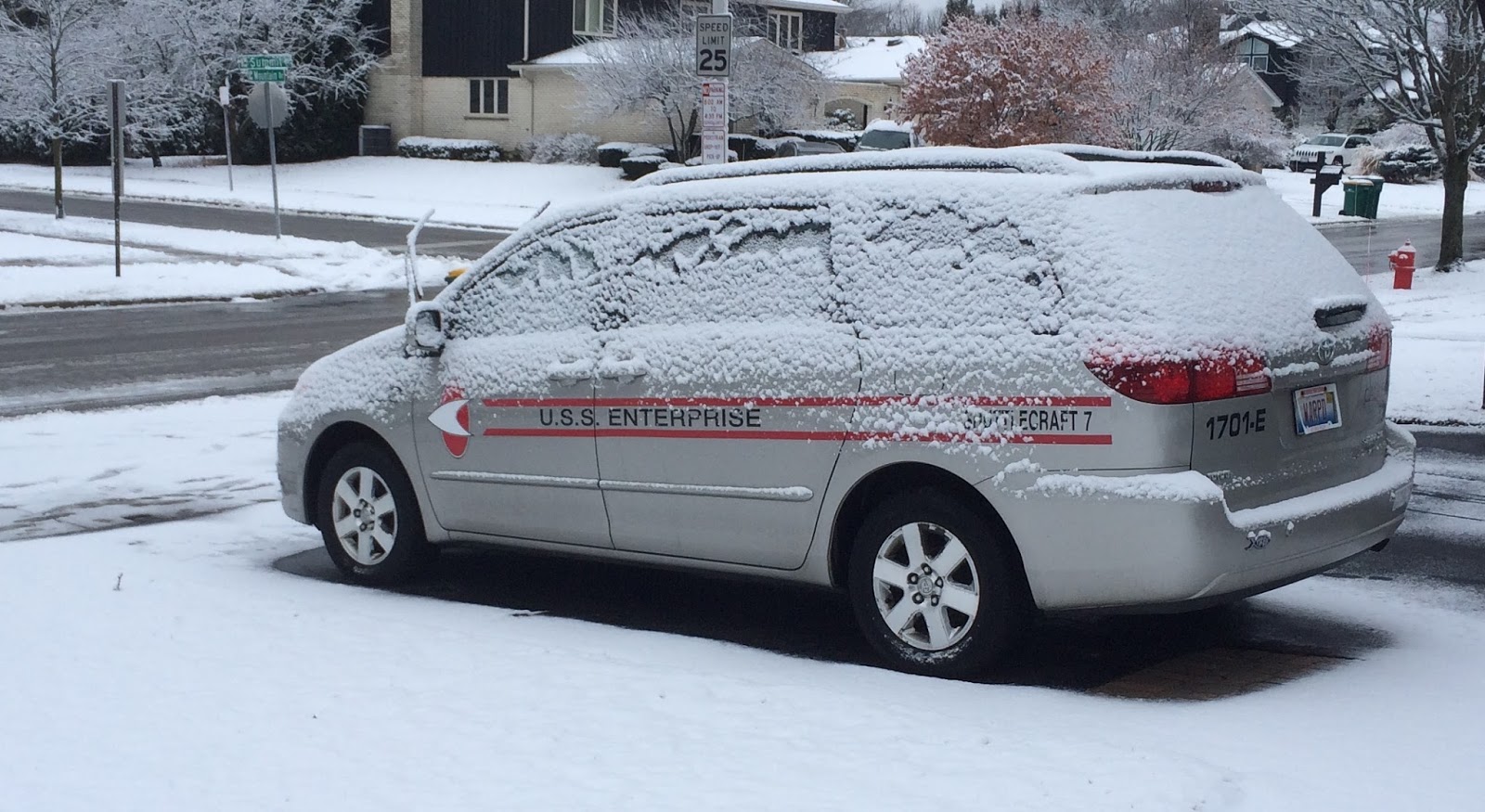
But my van was different. My van was a Star Trek shuttlecraft. It was one of a kind, down to the double entendre license plate. It became an extension of my identity in a way. In retrospect, I wonder if that was healthy.

I was always shocked that my students knew about the van because I didn’t drive it to school! It didn’t matter. People in the community knew the van and recognized it. Weekly, I would run into someone in a store who would say some variation on, “I was looking for you. I saw the van in the lot, so I knew you were here.”

It was fun, funny, and sometimes odd when we came outside and found someone photographing the van. Everyone in the family could return a Vulcan salute from a passing vehicle on the highway. The van made people smile. It was a fun way to travel.

When I turned fifty years old, I bought a car; the van lost its spot in the garage and moved to the driveway. It became the “extra” car the kids drove or was used for special occasions. But it was still there. More than that, it was even more public since it was now in front of the house.

My children called it the “nerdmobile.” My brother thought kids at school would make fun of my children because of it. If that happened, I never heard about it. In fact, the kids had a sweet fondness for the van. It was a kind of member of the family. It was like a symbol of both my fatherhood and fandom. It was our presence on the road.

And now it is gone.

I procrastinated in both preparing to sell it and then actually making the sale. Logically, it was time. It needed repairs that we could not justify given how infrequently it was used.

But vans don’t live on logic alone.

I created an ad and, when no fans stepped forward to purchase it, I decided to make the break quick and clean and sold it to Carmax. On the way home, I was wondering if I had made the right choice. My wife had an evening meeting and I moped and grieved the rest of the night, alone in the house.

Just to be clear: my current car has no decorations. I have no plans for another Star Trek vehicle. I moved some pieces of the van into my car. I will eventually put its plates on the wall of the garage.

I wasn’t certain that I could – or should – write about selling the van. It felt silly and trivial. I was relieved and grateful when others shared their stories. It was heartening and reassuring when I posted about the van’s sale on Facebook and people understood what I was feeling.

It is odd to come home to an empty driveway. It is odd to come home to a house with no children. I am very slowly getting used to both. I will miss the van and all it represents. More than that, I miss the people it shuttled and schlepped.

Saturday, February 24, 2018

Thou Shalt Not Kill: The Defense of Guns is Immoral

Thou shalt not kill, or properly translating the Hebrew, thou shalt not murder. What is difficult to understand about this? This statement sits at the core of almost all religious and moral codes. No matter whom you believe issued this commandment, it is the centerpiece of this issue. The debate about safety in our schools, gun control, and the second amendment is missing this key idea!

The statement does NOT read, “thou shalt not kill, except in school.” Or “Thou shall kill if someone threatens your ownership of weapons.” It doesn’t say that arming good folks is okay to defeat bad folks. Nope. Don’t kill.  No murder. Clear enough? It doesn’t matter if you are talking about a gun or the person using it: no murder. None!

Regardless of your views about guns, could you deny that murder is wrong? How can people of integrity and those who see themselves as religious object to attempts to stop murder and safeguard innocent lives? How can people who are anti-abortion be pro-school slaughter?

If protecting our children from being murdered is not a high enough priority, what is? And by “protecting,” I don’t mean more murder. I mean preventing, not reacting or responding. A gun in a school is the problem, not the solution. Many a murder has taken place with armed guards present.

An argument in favor of placing more guns in schools says that we don’t really want protection, we want more murder. We want kids killed in the crossfire or before the “bad guy” can be stopped.  By the time the gun arrives at school, church, or the movie theater, the battle is lost. We must do better than that! And arguments about guns and the military, arming teachers, hunting, and other distractions are attempts to turn the conversation away from the real issue. They are deflections and diversions.

What does it mean to say that unregulated and slavish worship of gun ownership is the value we hold most dear? Is your weapon is more important than our children or safety? The evidence is overwhelmingly clear: guns in civilian hands do not make us safer.

These massacres are intimately connected with racism, hatred, and sexual violence. Are these the values we hold dear? In addition to automatic killing machines, will gun lovers also defend these horrors? Where are those who speak of law and order? They want to protect us from foreigners, whom they say will do bad things, but will defend those at home who are actually committing horrible acts! This is crime and disorder – and it’s immoral tacit supporters.

Inaction is immoral. The long rationalizations, diversions, semantic gymnastics, and retreats into straw arguments are the last refuge of an inherently evil proposition: we must address the issue of guns or sacrifice those we love – as well as our integrity, morality, and safety.

Where are the statespeople who have the courage to solve these problems? Where are the real leaders who will face the problem and act? The students of Parkland, Florida are leading the crusade as the current administration wades further into a swamp of sin. 

If our elected officials don’t have the moral fortitude to act, they are failing us and do not deserve to serve. It is already too late. Now is not soon enough.

There are many issues that are difficult, complex, and tangled. This is not one of them.

Thou shalt not kill. Thou shalt not murder. Thou shalt not be an accomplice to murder. Thou shalt not watch children be slaughtered in their schools and do a rhetorical tap dance justifying their massacre. Stop the shootings!

Sunday, February 11, 2018

Defining Our Terms

Given the nature and content of our public conversations, I thought it might be helpful to define some of the words that we use so often. The following definitions are from the Merriam-Webster dictionary:


Honor:

·    good name or public esteem : reputation
·      a showing of usually merited respect : recognition 
·      privilege 
·      a person of superior standing —now used especially as a title for a holder of high office 
·      one whose worth brings respect or fame : credit 
·    an evidence or symbol of distinction: such as an exalted title or rank
·    an award in a contest or field of competition
·    archaic : a gesture of deference : bow
·      chastity, purity
·      a keen sense of ethical conduct : integrity 
·      one's word given as a guarantee of performance 


Moral:

·    of or relating to principles of right and wrong in behavior : ethical 
·      expressing or teaching a conception of right behavior 
·      conforming to a standard of right behavior 
·      sanctioned by or operative on one's conscience or ethical judgment 
·      capable of right and wrong action 


Responsible:

·    liable to be called on to answer
·      liable to be called to account as the primary cause, motive, or agent 
·      being the cause or explanation 
·    liable to legal review or in case of fault to penalties
·    able to answer for one's conduct and obligations : trustworthy
·    able to choose for oneself between right and wrong
·      marked by or involving responsibility or accountability 
·    politically answerable; especially : required to submit to the electorate if defeated by the legislature —used especially of the British cabinet


Trust:

·    assured reliance on the character, ability, strength, or truth of someone or something
·    one in which confidence is placed
·    dependence on something future or contingent : hope
·      reliance on future payment for property (such as merchandise) delivered : credit 
·    a property interest held by one person for the benefit of another
·    a combination of firms or corporations formed by a legal agreement; especially : one that reduces or threatens to reduce competition
·      care, custody 
·    a charge or duty imposed in faith or confidence or as a condition of some relationship 
·    something committed or entrusted to one to be used or cared for in the interest of another
·    responsible charge or office
·    archaic : trustworthiness


Justice:

·    the maintenance or administration of what is just especially by the impartial adjustment of conflicting claims or the assignment of merited rewards or punishments 
·      the administration of law 
·      especially : the establishment or determination of rights according to the rules of law or equity 
·      the quality of being just, impartial, or fair 
·    the principle or ideal of just dealing or right action 
·      conformity to this principle or ideal : righteousness 
·    the quality of conforming to law
·      conformity to truth, fact, or reason : correctness


Loyal:

·    unswerving in allegiance: such as faithful in allegiance to one's lawful sovereign or government 
·      faithful to a private person to whom faithfulness is due 
·      faithful to a cause, ideal, custom, institution, or product 
·    obsolete : lawful, legitimate