Showing posts with label Star_Trek. Show all posts

Thursday, March 28, 2024

If You Haven't Been to A Fan Run Science Fiction and Fantasy Convention, You Are Missing Out!

My family thinks I go to the big commercial conventions that get a quick story on the TV news, but they are not the conventions I love and regularly attend. I go to conventions that are for the fans, run by the fans, and are joyous, inclusive, and multifaceted celebrations. 

What’s the difference? 

My science fiction and fantasy (SFF) conventions are not for profit. They are run by a team of amazing volunteers. They are not marketing or sales events. These conventions are usually much smaller, a few hundred to a few thousand people, and are held in a hotel, not a conference center. These conventions are local and connected to their cities, towns, and states. They feature a wide variety of activities instead of one or two big stages. They have panels, of course, but also music, art shows, gaming, films, exhibits, performances, food, costumes, activities for children, demonstrations, and a dealers room. These dealers rooms are smaller than the massive rows of merchandise at for-profit conventions, but they feature local small businesses, booksellers, authors, and craftspeople. 

Local conventions are focused on movies, television, games, and books! In fact, many local conventions are part of a network called the World Science Fiction Society that sponsors an annual World Science Fiction Convention (usually called Worldcon). This summer it is in Glasgow, Scotland. In 2025, it will be in Seattle, Washington. At Glasgow, the attendees will vote on where Worldcon will be in 2026! 

At Worldcon, in addition to all the activities above (and more), the annual Hugo Awards are given. This is the science fiction and fantasy community’s Oscar night; the awards given by the fan community. It is a splendid and spectacular event – and if you are part of Worldcon, you can vote! 

Community is one of the key features of a local not-for-profit convention. The larger events are done by professionals and used as marketing vehicles for studios and networks. Smaller, local conventions invite participation, conversation, and community. Newcomers are welcomed and become part of the family. Sure, you can purchase stuff, but the fandom community is the center of the celebration – not the selling or marketing of products. 

Do you enjoy reading or watching science fiction or fantasy? Do you want to discuss your ideas with others? Do you long not to be told that “you are the only one interested in that?” Then these conventions are for you. 


Oh, yeah, they are way less expensive than the cons that have to pay stars, rent huge exhibition halls, and advertise in the media. They are the best convention value around -and they might just change your life! 

I like going to an occasional Comic Con like C2E2 in Chicago or Wizards World or Creation’s Star Trek conventions. There is a place for both kinds of conventions. However, if I had to choose one, I would go to my local conventions without hesitation. My people are there. My friends are there. I am not merely an audience member, I am part of the family. I don’t spend my entire weekend sitting in a seat in a huge auditorium watching something far away. I go to panels about books, television shows, and topics like science, humor, music, and games. I wander through a wonderful art show and talk to strangers (who become con friends) and have a nosh at the con suite. I listen to poetry and singers at the café (and see others enjoy the coffee). I might learn about constructed languages and get a basic Klingon lesson. I reminisce about books, movies, and TV series that I cherished from long ago. I participate in book club discussions. 

Join us! There are local cons everywhere. I regularly attend the two Chicago area conventions: Windycon in November and Capricon in February. In July, I travel to Minneapolis for Convergence. I try to go to the Worldcon in the late summer. Come join the celebration! Come have those wonderful discussions you can only have with people who share your love for these special genres. And if you really like it – volunteer and make it even better! 

And if you see me, please come over and say, hello!

Tuesday, July 11, 2023

Forgetting the Painful Past: Strange New World’s “Among the Lotus Eaters”

What happens if you can no longer recall who you are and where you come from? What are the effects when groups’ collective and individual memories are erased? What are the political implications when parts of society retain their history and other parts lose theirs? 

These are questions many people are asking when Black, Queer, and other histories have been removed from public school curricula. Legislators in several states have banned the teaching of subjects that they think will make some children uncomfortable while their removable makes others upset. Clearly, these topics might also make some adults uneasy. 

I don’t usually write reviews, but as I read commentaries on the most recent episode of Star Trek: Strange New Worlds, no one directly addressed how this episode connects to this issue. 

In “Among the Lotus Eaters,” the crew of the Enterprise returns to a place of pain. They must “clean up” the mess they made when they had a very short but tragic visit to a planet in which three crew members died and several others were wounded. This visit seems to have resulted in “cultural contamination” where the iron age culture of the planet somehow has a Starfleet symbol, a clear violation of their non-interference order, the Prime Directive. 

Captain Pike and his crew must face their terrible past and try to deal with their interference in the development of this primitive world. Pike holds himself accountable for the fates of those under his command and accepts the responsibility of setting things right. However, when his crew arrives on the planet, they find these primitive people have phaser weapons and the delta symbol of Starfleet adorns the gates to their castle. Something is horribly wrong. 

Pike discovers the cause: one of the crew members Pike believed had died survived and made himself the ruler of the planet. Pike and his crew are attacked and awaken in a cage – and they no longer know who they are, why they are there, or what happened before. They have lost their memories. 

The dynamic of a ruling class that can retain their memories and a worker class that has no memory seems to me to be a science fiction commentary on our refusal to face our country’s past, whether our relatives were part of it or not. Even outsiders, like the surviving crew member, benefit from and exploit this memory-based caste system. 

When Pike and his landing party confront another worker, the worker rationalizes his lack of memory telling them that memories would be painful. The worker doesn’t want to remember his family, if he lost them. He doesn’t want to feel grief, pain, anger, and unhappiness. Having no memory saves him from this kind of discomfort and makes his toil more bearable. Sound familiar? 

However, our Enterprisians, even without their memories, retain key parts of themselves. Captain Pike knows that he has been separated from someone he loves and instinctually takes leadership. Lt. Ortegas finds strength in her ability to pilot the ship. Dr. M’Benga is driven to heal those in pain. 

When Pike finally confronts the wayward crew member, we learn that the ruling class has been manipulating the workers with fiction about their lost memories. They have used the workers’ lack of history to their political advantage. People without a past don’t cause problems or challenge the rulers. Repressing history and losing memory are the key elements in maintaining this abusive society. 

As our crew regains their memories and figures out how they came to be in this situation; our guide remembers his lost family. Tearfully, he acknowledges that even painful memories are better than none at all. 

In Greek mythology, the lotus eaters were a community that ate a fruit that put them into a drug-like sleep and thus they did not care about important things. They needed to come out of their daze and wake up in order to take real action. 

This episode was about the danger of falling asleep, losing our history, and thus losing ourselves. The danger was not only for the crew of the Enterprise on Rigel VII, but, a comment about our current world.  

We need to wake up! We must not lose our histories and thus lose ourselves. We must not let people erase the past for political power and personal gain. Our individual and collective histories are critical to us and our societies. As Captain Pike notes at the end of the episode, such forgetting is not a natural development. He rightfully justifies altering the situation so everyone may remember and takes the power-hungry despot into custody. 

There has been a lot written about how the newest Trek shows are “woke.” There have been complaints that they make political statements. The original Star Trek in the 60s made bold and clear statements about everything from racism to the Vietnam War. Star Trek and science fiction are, by their very nature, social and political commentary. 

This episode was directly addressing the need to hold on to our history, even when it is uncomfortable to face. It challenges us not to become lotus eaters but to wake up and confront the problems of our uncomfortable past and clean up the messes that we have made or inherited. 

Whether or not you agree with the message, “Among the Lotus Eaters”  does what good science fiction, good Star Trek, and good literature always does: use stories and characters to help us see our world in a new way – and inspire us to change for the better. 

Wednesday, May 17, 2023

Twenty Years Ago: May 2003

On May 1, 2003, President George W. Bush declared that, in Iraq, our mission had been accomplished and “major combat operations” were over. He was very wrong. 

At that time, I was keenly aware that, as a parent and teacher, not only was my mission not accomplished, but my major operations were only beginning. It is ironic that, twenty years later, many of my missions are accomplished (This is not the place to debate the state of Iraq). I look back at May of 2003 and it is nearly the opposite of my life now. 

My mission at school was in full swing. I had Peer Helping meetings two or three mornings a week. I was preparing for the student performance of creative writing, StageWrite, after school, later in the month. I was getting my Sunday School students ready for their May confirmation, and I was meeting with a new teaching team and designing our class for the fall. I started my adult Hebrew class, too! 

Operations at home were complex and intense. Unlike now, my children lived at home. I moved them from violin to sports practices to the park district to birthday parties and doctor appointments. Oh, yeah, they had school, homework, and Sunday School, too! 

My mother-in-law was at a nursing home in Skokie. My wife visited her frequently. My parents and my wife’s aunt helped us by picking up my kids and taking them for sleepovers and filling in when our babysitter got sick, which happened a lot in May 2003. My wife’s aunt died seven years later, and now I am frequently helping my parents.

Oddly, I didn’t see myself as frenetically busy as I do when I look back. In my journal, I wrote, “Today felt so – reasonable! I don’t remember when I have had a day when I got everything done and I didn’t feel like a madman doing it.”  But I continued, “I taught three classes, got the school work done (I didn’t have grading today – that helps). Web, attendance, special ed forms, calls, reading, and then temple, North Trail, and all the rest – but done and no craziness. What have I forgotten?”  So maybe not so reasonable? Of course, just a day later, I write, “From sane and reasonable to crazy and hectic! The day is only a few hours old and already things are nustybaum.” Are you shaking your head? I am. I was so busy that one of my journal entries ends midsentence as if I was called away and never had a chance to finish it. 

I worked out on my exercise bike most mornings. My body was letting me know that I was stressed: my neck and back hurt. I made my morning workouts more palatable by watching TV shows, but Star Trek: Enterprise had its series finale in May 2003. 

A good metaphor for my life at that time was the way that I organized my students’ debate presentations. Students were in groups of four, debating two on two. It might take ten class sessions if we saw them one at a time, so I found empty classrooms and put cameras in them, and had multiple debates for two or three days. Kids had to report to our room, find their debate room, and then set up and operate the camera, keep time, and debate! I would then take all the recordings home and grade them. It was stressful, intense, and exhausting for me, great for the class schedule and the kids. 

I ran a fundraising road rally for the congregation, which was a mix between a treasure and scavenger hunt. I organized a Mother’s Day brunch for my wife, mother, sister-in-law, and aunt-in-law. My daughter had another wrist x-ray and then we went to the Bakers Square which was demolished this week. My son had an ear infection! We went to the spring play, gymnastics tournaments to watch a former student, and Honors Night. I was a human pinball. 

Much of my free time was filled with grading (and watching those debate recordings). I also started meeting with a group of teachers who team-taught classes. Those meetings meant I was not in my regular classes, which meant sub plans and thus additional work. 

Yet, I read to both kids every night. We had our mornings together, too, even if it meant that when we left the house, it looked like the kitchen had been ransacked by raccoons. We went to dinners at Sweet Tomatoes on a regular basis, which was my children’s favorite restaurant. I rode my bike with my daughter to her school in the morning until she felt comfortable riding by herself. We even had an occasional Saturday babysitter and went to see the movie, Bend It Like Beckham! 

Like today, I was very aware of my good fortune. I wrote, “I am so lucky, so very very very lucky.” Despite a relative’s divorce and my mother-in-law’s condition, the rest of the family worked like a well-oiled Rube Goldberg machine. I noted that I did a “thousand things today,” but I wasn’t overwhelmed or unhappy about it. As with prior months, reading my old journals exhausted me now – but not then. 

I don’t know when we’ll be able to really say, “mission accomplished” in the middle east. It was May of 2003 when the Israeli government approved a plan that they thought would create a two-state system by 2005! 

Looking back lets us shake our heads at the past. It emphasizes how our view then is different from our reality now. Yet, it is our past that formed this present and what will come next. I think that frenetic pace is why I love the quiet and calm of retirement.

Friday, March 24, 2023

Reading For Treasure: My Articles!

Reading for Treasure is my list of articles that are worth your attention. Click here for an introduction!

In the past few weeks, I have had an essay published and been featured in an article in two Jewish publications. So, this month, here are these two articles, both dealing with religion. 

When Humanistic Judaism Magazine decided to focus its winter issue on Judaism and science fiction, several people reached out and asked me if I’d like to contribute. It is true that my first experiences with science fiction were at my congregation’s religious school on Sundays. My love of science fiction and my philosophy as a Secular Humanistic Jew are two of the most important elements of my identity. So of course, I wrote a piece similar to my blog posts. This link is to the preview version of the magazine. My essay, “Sunday School Made Me a Science Fiction Fan,” is on page 12. 

Tablet Magazine is a Jewish publication that covers a wide range of topics from news and religion to culture, history, and sports. They have been exploring the diversity of the Jewish community through a series of discussions called “The Minyan,” which they describe as, “Roundtables on the state of the American Jewish community, bringing together people from a shared demographic or background—everyday people with personal opinions, not experts who earn their salaries discussing these issues.” A reporter reached out to me to participate in an online gathering of Jews who did not believe in God in the traditional sense of the concept. The reporter gathered a group virtually and we had a fascinating and thoughtful conversation that was published in this article. In addition to the article, a podcast version of this conversation will be released sometime soon.


Currently, I am reading Babel: Or the Necessity of Violence: An Arcane History of the Oxford Translators' Revolution by R.F. Kuang


Friday, August 26, 2022

Reading For Treasure: Hope from Star Trek and Science Fiction

Reading for Treasure is my list of articles that are worth your attention. Click here for an introduction!

There is a new science fiction sub-genre called hopepunk. According to Wikipedia, hopepunk stories “are about characters fighting for positive change, radical kindness, and communal responses to challenges.” Coined by author Alexandra Rowland as the opposite of grimdark, “The aesthetic of hopepunk is generally agreed to incorporate a mood of gentleness or softness and a sense of self-awareness of weaponized optimism, with a worldview that fighting for positive social systems is a worthwhile fight. There is an emphasis on cooperation as opposed to conflict. There is an awareness within hopepunk works that happy endings are not guaranteed and that nothing is permanent.” Here is the Vox article from which that quotes come: “Hopepunk, the latest storytelling trend, is all about weaponized optimism.” 

Some Star Trek stories could certainly be hopepunk. Emmet Asher-Perrin writing on Tor.com explores the way that the latest incarnation of this franchise, Strange New Worlds, takes the Hero’s Journey and turns it into something far more important and optimistic than the way it shows up in superhero and other traditionally portrayals: “How Star Trek: Strange New Worlds Reimagines the “Hero’s Journey” for the Better.” Be aware there are spoilers in this article. 

CNN also recognized the power of Star Trek’s hopeful outlook: “The New ‘Star Trek' series couldn’t come at a better time.” This article does not have spoilers and is safe for those who have not yet watched Strange New Worlds – and you should! 

Star Trek has improved the real world in many ways: one of the most powerful and hopeful is the work of Nichelle Nichols, who played Lieutenant Uhura in the original series. The article, “From Star Trek to the White House, The World Remembers Nichelle Nichols” from TrekMovie.com is much more than a list of tributes from important voices. It also includes several wonderful video tributes, so scroll to the end. The documentary about Ms. Nichol’s work on the space program, Woman in Motion, it is also well worth viewing. Like all of Star Trek, it is on Paramount+. 

During the worst of the early pandemic and the years that preceded it, I found solace and hope in a quirky half-hour situation comedy called The Good Place. This lovely expert from a book by its creator,  Michael Schur, explores some of the powerful and optimistic philosophic questions that made the series such a delight. The Literary Hub published the excerpt, “Good Place Creator Michael Schur Wonders: What Makes Someone Good or Bad?” If you haven’t seen this series, it is worth a watch! 

Star Trek and several other on-screen science fiction franchises have been working hard to be inclusive. The first of the “Nu Trek” series, Star Trek: Discovery,  features a Black woman in the leading role (and now, finally, as a captain) and all five of the new series have gone where no science fiction show has gone before with representation. Nonetheless, there are fans that were shocked to see that Star Trek (and some other famous series) are so left-leaning. I don’t how they missed the message in earlier incarnations of Trek. So we’ll finish with a little laughter at their expense from Carolos Greaves in McSweeny’s, “This Fictional Universe is Getting Way Too Diverse.” 

I am currently reading A Master of Djinn by P. Djèlí Clark. 


Saturday, May 7, 2022

Twenty One‘derful Years of Sunday School

I am retiring – again. I have been teaching Confirmation Class on Sunday mornings for twenty-one years. When we started the congregation in 2001, we wanted to be a full-service congregation; that meant a religious school, so I volunteered to teach Confirmation Class. 

We began with the curriculum from our prior congregation. It focused on comparative Judaism and comparative religion. I started with the continuum of Judaism. I took kids to Shabbat services at reform, conservative, reconstructing, and orthodox synagogues –and asked them to come to one of our Friday night services. Of course, high school students (and their parents) have many other things happening on Friday nights or Saturday mornings. And many students had been going to their friends’ mitzvahs at the very same congregations we were visiting. We had some very interesting conversations. 

I told students to dress nicely for these visits as they would for a B Mitzvah. When we visited a conservative synagogue for a Friday night service, one of my students arrived in a very short skirt and a bare midriff. I took off my coat as I saw her come into the sanctuary and said to her, “Put this on, you must be freezing!” I learned to be much more clear about my dress expectations. 

We also studied world religions and visited a Catholic Church and a nearby mosque. Through these seven field trips, the connections between all the religions were increasingly clear to the kids and me – and we were exhausted. It was too many field trips! 

In the third year, I decided to do a little of each: we studied some comparative Judaism and some comparative religion. I organized the years around the structures of the religions – and scheduled all field trips on Sunday mornings! One year, we went to an Orthodox Jewish shul, the Catholic church nearby, an Evangelical megachurch, the local mosque, and a Hindu mandir. The other year, we went to the Unitarian church, a United Church of Christ church, the Buddhist temple, the Bahai House of Worship, and a “classical reform” Jewish congregation that still had Sunday morning services. Five field trips a year was much more reasonable. 

And now, ninety-one kids, eighty-four field trips, and 470 class sessions later, I am handing Confirmation Class over to another teacher. Although I still love learning with students, the structure of Sunday mornings has become too restrictive. Both of my adult(ish) children live and work out of town. If I visit them, our time together must be on weekends. It is too hard to find ways to travel to see my kids and be back on Sunday mornings – and I feel way too guilty missing class. 

It has been a fantastic twenty-one years. I have learned with outstanding students. I have worked with fantastic colleagues and parents. I have talked with remarkable clergy. It has been joyous! 

In the beginning, my own children came to Sunday school with me. They would help set up my classroom and then run off to their own. We rejoined each other for the last half-hour, when the entire school gathered to sing. My parents would come to these music sessions, as would the parents (and often grandparents) of many of the students. It was a gathering of the congregation and a highlight of my week. 

I knew almost all of the families well. Once, as class came to an end, I joked with a student, telling him, “I’m going to tell your parents about this.” He looked at me and replied, “I’m going to tell your parents!” What a beautiful thing that he could! 

Every time we would study a religion or visit a different house of worship, I would learn with the kids. The first time we drove up to the huge megachurch, one of my students leaned over and said, “Oh, Mr. Hirsch, you’ve made a mistake. This is a mall!” Nope. It was a church – and it was bigger than a mall. 

I loved the moment that we drove through the gate at the BAPS Shri Swaminarayan Mandir in Bartlet. I showed the kids photos. We had read about Hinduism. But nothing could adequately prepare them for the first sight of that magnificent structure. The collective gasp as we arrived more than made up for the long journey to get there. 

There have been challenging and memorable moments, too: the student who asked our host at the megachurch, “So, are we all going to hell?” The time a guide compared homosexuality to heroin addiction and my students were so flabbergasted that they literally began to move toward her. The pastor who was so approachable that one of my students whispered to me, “These are the coolest Christians I have ever met.” The charming and affable host at the mosque who just didn’t sit down, so we had our half-hour discussion standing (and swaying) on our feet. The host who thought, since he had grown up Jewish, that he was knowledgeable about our religion and made assumptions that were increasingly uncomfortable. The wonderful shofar-making activity at the orthodox shul – and the stuffed goat, and bumping into friends and neighbors at the Catholic church. 

One big issue we discussed a great deal is god. It is a very popular and important topic. We explore different ideas about god and different ways to conceptualize theism. I even show the Star Trek: The Next Generation episode, “Who Watches The Watchers” to help us articulate questions and answers about the concept of an anthropomorphic god. 

We didn’t study religion purely academically. The point was to think critically about our own beliefs. We learned about how others answered important religious questions so that we could explore them ourselves. We wrestled with moral dilemmas, talked about what it meant to proselytize, and discussed the line between belief and behavior. The test of belief is how it shows up in our daily lives. How do we walk our talk? How do our beliefs shape our identities and decisions? 

At the conclusion of the two-year class, students get a chance to talk about what they believe. At our confirmation service, they focus on one part of their journey they want to share. Some students talk about god. Some talk about different views of Judaism. Other students focus on some of the questions we asked on our field trips, ethical issues, or their own stories. One young woman started out by telling us that, to her, her mother was god. A young man described his ethical code simply by saying he did his best to “not be an asshole.” Another explored the difference between confirming and conforming. Students sometimes challenged or questioned things they had learned. They wrestled with the concept of what makes something a religion. They described how they navigated conversations about religion with their friends. Year after year, their reflections made me think about my own philosophy and how I could better guide the next group of students. 

It has been a privilege to learn at Kol Hadash’s Sunday School. It has been an honor to study with these students, teachers, and parents. I often said that I am the lucky teacher at the end of the line. I benefited from all the magnificent learning that happened in the classes before Confirmation. From our youngest students learning songs and holidays to studying lifecycle events, heroes, Israel, and wrestling with the Holocaust, students are well prepared for Confirmation Class. I can’t take credit for their brilliance. They have been primed by their families and their earlier classes. I am very proud of them when they stand before the congregation and share their wisdom. 

I am grateful to students with whom I have learned – and their families. Their commitment to Jewish learning is inspiring. I am grateful for the incredible teachers and education directors with whom I have worked – and our outstanding rabbi. For the last three years, I have co-taught Confirmation Class with a teacher who is one of the most able, empathetic, and perceptive educators I have ever met. She will take over Confirmation Class next year. It will be a big upgrade. 

I am only retiring from teaching. I am still very involved in our congregation. I chair our fundraising committee, sing in the choir, and do a variety of other tasks. And if someone needs some help on Sunday morning, I am happy to assist. I live next door, after all.  

When I was a young child, my parents never expected to find a congregation at which they would feel comfortable. When they found Humanistic Judaism, it matched their philosophy and the way they lived their lives. There are so many families like us out there. It gives me such nachas that our congregation and school continues to be a warm and welcoming place for anyone who wants to confirm that Judaism can be celebrated culturally, secularly, non-theistically, and joyfully! 

Sunday, April 24, 2022

Return to the Comic Cons: Cons Run By Fans and Cons Run For Profit

I attend science fiction fan conventions. Since I was in high school, I have loved their community, conversation, and connection. The first conventions I attended were not-for-profit events run by fans. The folks organizing these conventions were doing it for the love of fandom. 

These conventions featured panel discussions, film, video, and game rooms, music events, art shows, dealers' rooms, con suites (to eat and talk), and countless other planned and unplanned fun. They were immersive all day (and much of the night) experiences. The featured guests at these conventions were usually writers, artists, and, in the early days, movie and television creators and stars. Even when I attended alone, I was pulled into parties, conversations, and made friends I still see at cons today. 

In the eighties, soon after the premiere of Star Trek: The Next Generation, I attended some conventions run by companies for profit. These conventions were different than the fan cons. Initially, these pro conventions only had two spaces: a main stage and a shopping mall. Sometimes, there were exhibit spaces as well. The guests at these conventions were almost exclusively movie and television stars and creators. 

Over the years, I had seen all of the original Star Trek series cast and many from the other series at a fan-run convention in St. Louis called Space Trek. However, as the pro cons grew, they became the primary or only way to see the on-screen (or screen-related) celebrities. 

At these pro run cons, I often felt like a commodity. These for-profit conventions were shows. I found a seat in a big main stage room and stayed there most of the day. Many of the presentations felt like commercials. I felt like the Ferengi had taken over the con business. 

To be fair, a few of the fan-run conventions focused far more on literary science fiction than television, movies, or comic books – sometimes with a problematic attitude. I remember a person at a panel sneering, “Haven’t you ever read Left Hand of Darkness?” But this was not true at all fan cons; each one had a unique personality. 

I was introduced to science fiction through short stories and novels and I have always been a reader. I am also an enthusiastic fan of genre television shows and movies. There are fan conventions that catered to all of these interests, even if some had a higher-brow tone. But the pro conventions focused on comic books and media (and related products). The fan cons focused on what the fans who organized and attended them wanted: some were more literary, some were more media-focused, and some included anime, comic books, music, art, and more. 

In the 90s, I was immersed in my career and family, so spending the entire weekend at a convention was impractical. Sometimes, spending a Saturday was a luxury.  I did my best to go to the two local fan-run conventions, Windycon and Capricon, as often as my schedule permitted – which wasn’t as often as I wanted. 

For decades, my connection to fandom was through these two conventions. I did not attend the big comic cons that had become popular or the professionally run conventions focused on Star Trek or newly popular franchises. Since I didn’t have as much time (or money) for conventions, when I went, I wanted to connect with community and have substantive conversations and experiences. The pro cons felt like cotton candy, the fan cons were a sustaining meal! 

As my children and I grew older, I attended a few fan-run World Science Fiction Conventions, which were everything I loved about conventions writ gargantuan. I ventured out and went to a few fan-run conventions out of town. 

Recently, I retired. Now, I have time. I attended my first comic con, C2E2 (Chicago Comics and Entertainment Exhibition). When the folks who run C2E2 announced a major Star Trek convention in Chicago, it felt like an opportunity to reacquaint myself with the pro cons. 

I enjoyed C2E2 and Star Trek Mission: Chicago. However, if I have to make a choice between these stage and store cons and the cons run by fans for fans, I am going to the latter. I had a good time and I met some nice people, but the connections were superficial and commercial. 

All conventions must make money. There are bills to pay. Convention spaces don’t donate their space or resources. However, the commercial focus at C2E2 and Mission: Chicago was prominent. For example, it was very clear that Mission: Chicago’s real mission was to sell the new Star Trek shows. It was peddling all sorts of products and subscriptions connected to them. That was its main purpose. The celebration, exploration, and community were by-products when fans buy products. 

I liked hearing from the stars and creators, yet I missed the analysis and thoughtful conversations that are often present during smaller panels. The comedian emcees at Mission: Chicago did not seem to be fans themselves and often, perhaps unconsciously, took a condescending tone. I sometimes felt like I was at an event for children. 

I met some very nice people and had good conversations with the folks sitting around me. We didn’t walk to the con suite and sit down and talk. We didn’t ask each other, “Where are you going next?” I doubt we’ll see each other at the next con. 

I was pleased to see that both pro conventions had some events beyond the main stage. However, they were few. There were a few costume-related events, a secondary stage, and a panel room (or two); skimpy by even COVID fan con standards. 

The pro cons are not cheap! They want high prices for entry – and all the stuff in the exhibit hall. They also sell products related to their famous star guests: autographs, photo opportunities, and other ways to rub shoulders with celebrities were main items on the menu– for a price. 

Fans created these conventions many years ago. Business people now use them as marketing tools. Conventions, for me, are far more than celebrities and shopping. 

I wonder what all the folks who go to these big productions would think of their local conventions? Would they join a fan group, help with a fan-based charity project, discuss a book, and become more substantively connected to the brilliant, inclusive, and thriving fan family? I hope so. The World Science Fiction Convention is coming to Chicago over Labor Day Weekend. Windycon is in November and Capricon is in February. Join us! 

Friday, December 18, 2020

VHS Time Capsule

Staying at home during the time of COVID has provided me with time to start to clean out all those old things stored in the basement. My family and I have thrown things away, packed up things for donations, and done a ton of recycling. 

Recently, we pulled four huge bins of VHS tapes out of the crawl space. In them were hundreds of recordings of Star Trek and other television shows I adore. I remember watching the first run of each series with a remote in my hand to edit out the commercials. I was certain that these tapes were going to be the way I got to watch these shows again. 

I had carefully labeled every tape. Each one had a list of the episodes inside the cover. I really felt like I was preparing my future viewing. I did not predict streaming services or DVDs. I no longer even own a video cassette player of any kind. 

So why is it so difficult to part with these tapes? 

It is not as if I am going to sit down and use the tapes, even though I do continue to watch much of the content that is on them. I don’t need old grainy analog tapes to do it. For several of the series, I have purchased DVDs that include closed captions and special features. 

The eldest of the tapes date back to the early 80s. My family was one of the last to purchase a VHS machine. I had been recording Star Trek on audiocassettes because listening was the only way I had to experience an episode other than when it was broadcast. So when that first VHS deck came into my house, there was no doubt what I was recording. 

I knew that the episodes I was recording were edited. I was aware that they had a few minutes cut from them for additional commercials, but at the time, there was no alternative. Even when I could purchase store-bought tapes of the episodes (which I did), they were expensive and I bought them slowly and savored each one. 

As I got older, these became my exercise tapes. I would watch them to make working out interesting and take my mind from the sweat and discomfort of riding a stationary bicycle at 5 in the morning. I still watch Star Trek while working out! 

I bought my own VHS recorder as a gift to myself for my college graduation. Star Trek: The Next Generation was being made and I recorded entertainment shows and tried to find any clip or glimpse of information about this new Trek. 

When the show finally premiered, I made sure that I was in front of the TV, remote in hand, for every episode. I recorded each one twice: once with commercials edited out and one with them left in. I am a big believer in backups. 

I did this for a very long time. 

I recorded The Next Generation, Deep Space Nine, The Original Series, and the Animated Series on these tapes. By the time Voyager and Enterprise premiered, my life had become too complex to edit them live. But now I had a host of other shows: Babylon Five, Earth Final Conflict, Farscape, Alien Nation, and even some I had forgotten (remember Seven Days?).  I have not rewatched all of these series, although as I write about them, I am eager to find the services that stream them, even if I don’t know when I will have time to watch all I would want to. 

I know that these tapes are not the way I will now see these shows. I know that there is no problem with throwing them away or recycling them. But doing so feels like losing something special; something that feels both far away and very dear and important. They are a kind of time portal into a distant past which I don’t want to lose. 

The technology may be obsolete, but the feelings and attachments are not. These tapes are mementos of watching these shows broadcast for the very first time. They are relics of a distant time, heavy relics that are taking up lots of space in my basement. Unlike my affections for these shows, basement space is not infinite. I am going to have to come to terms with letting go of these tapes and being content with the feelings they engender when I watch what was on them. 

The tapes did not record my wonder, joy, and delight in these stories and sagas. Those can never be lost! 

Saturday, May 19, 2018

Summer Science Fiction Reading and Viewing - Part 1

I taught a science fiction English class for the first time this year. This Monday is the last day. A student asked for recommendations for reading over the summer. I pointed back to our list of literature that includes more than thirty novels. Yet, there are plenty of novels that did not make that list because they were too long or felt inappropriate for use in class.

On the second to last day, my co-teacher and I asked our science fiction students to give us feedback by filling out a form. One student asked about Star Trek. This student thought since I am such a big fan, that there would have been a Star Trek unit.

I struggle saying goodbye to my seniors. I feel like anything I say is inadequate. And while I invite them to return for a visit, connect to me on social media to stay in touch, and to email me with updates, I fear that, when they walk across the stage at Ravinia, that will be the end of the story. And that makes me sad.

There are only a few things I treasure more than the gift of a good book (or movie or television show). So, for my almost former students, my actual former students, and for anyone else who is interested, here are some ideas for some science fiction summer and future reading and viewing. Beyond the joy of our relationship and time together, I can think of nothing better I can give you:

Consider reading the works that have been nominated for the Hugo award. The Hugo awards are open to anyone who participates in the World Science Fiction Convention. These novels, stories, and other works were all published or released last year. There are novels, stories of various lengths, non-fiction, artwork, television shows, and movies. If you like this list, look at past finalists and winners, too! Similarly, the Science Fiction and Fantasy Writers of America has its own awards called the Nebulas. Professional science fiction and fantasy writers select these awards. You’ll see there is some overlap between the two lists.

There are some titles on the class list that students have loved, and if you haven’t yet read, you might enjoy. I am not going to summarize or sell each book. I will leave it up to you to do a little research. Ready Player One by Ernest Cline was a big hit this year. Several students have suggested that it become required reading. Every group that read Fifth Season by N.K. Jemison loved it.

A few years ago, I made some lists of books that I love. Some titles from that group that we couldn’t put on the list for the course that you might enjoy include Stranger in a Strange Land by Robert Heinlein, Hyperion  (and The Fall of Hyperion) by Dan Simmons, Ancillary Justice by Anne Leckie, and American Gods by Neil Gaiman.

Going beyond the lists, here are a few more titles to consider:
Dune by Frank Herbert (give it at least 250 pages – be patient!)
Contact by Carl Sagen
Redshirts or Lock-In by John Scalzi
Lathe of Heaven by Ursula Le Guin
Bellwether by Connie Willis
The Princess Bride by William Goldman
The Dragonriders of Pern series by Anne McCaffery

Remember, short stories work, too! I love the collection Welcome to the Monkey House by Kurt Vonnegut Jr. Ray Bradbury has several collections including Illustrated Man, I Sing the Body Electric and The Martian Chronicles. The Locus reading list even links directly to many pieces of short fiction!

Yes, I know that my recommendations could be more diverse and I am working on this. Stay tuned.

Speaking of tuned, here are a few movies you might want to add to your summer viewing:

2001: A Space Odyssey
The Adventures of Buckaroo Banzai Across the Eighth Dimension
Arrival
Brazil
Galaxy Quest
Gattaca
Mad Max: Fury Road
The Nightmare Before Christmas
The Princess Bride
Raiders of the Lost Ark
Star Wars (the original)
Sleeper

Finally, if you want to know what Star Trek is all about, here is a list of episodes and movies to view that will give you an idea of why I love it so much.

Begin with episodes from the original series:

"Where No Man Has Gone Before"
“Balance of Terror,"
"Shore Leave,"
"Devil in the Dark,"
"City on the Edge of Forever."

Look at a few of the films:
Star Trek II: The Wrath of Kahn
Star Trek III: The Search for Spock
Star Trek IV: The Voyage Home

Then you are ready to move into the other series, which I will include in a future post like this.

I also strongly recommend The Final Reflection by John Ford. It is a Star Trek book, and it is outstanding science fiction. It is worthwhile even if you are not a Star Trek reader.

I know this collection leaves out very important novels, movies, and television series. It is woefully incomplete, thus the “part 1” in the title. The most important thing is to keep exploring: books, movies, graphic novels, and anything else – and then share them!


Saturday, March 10, 2018

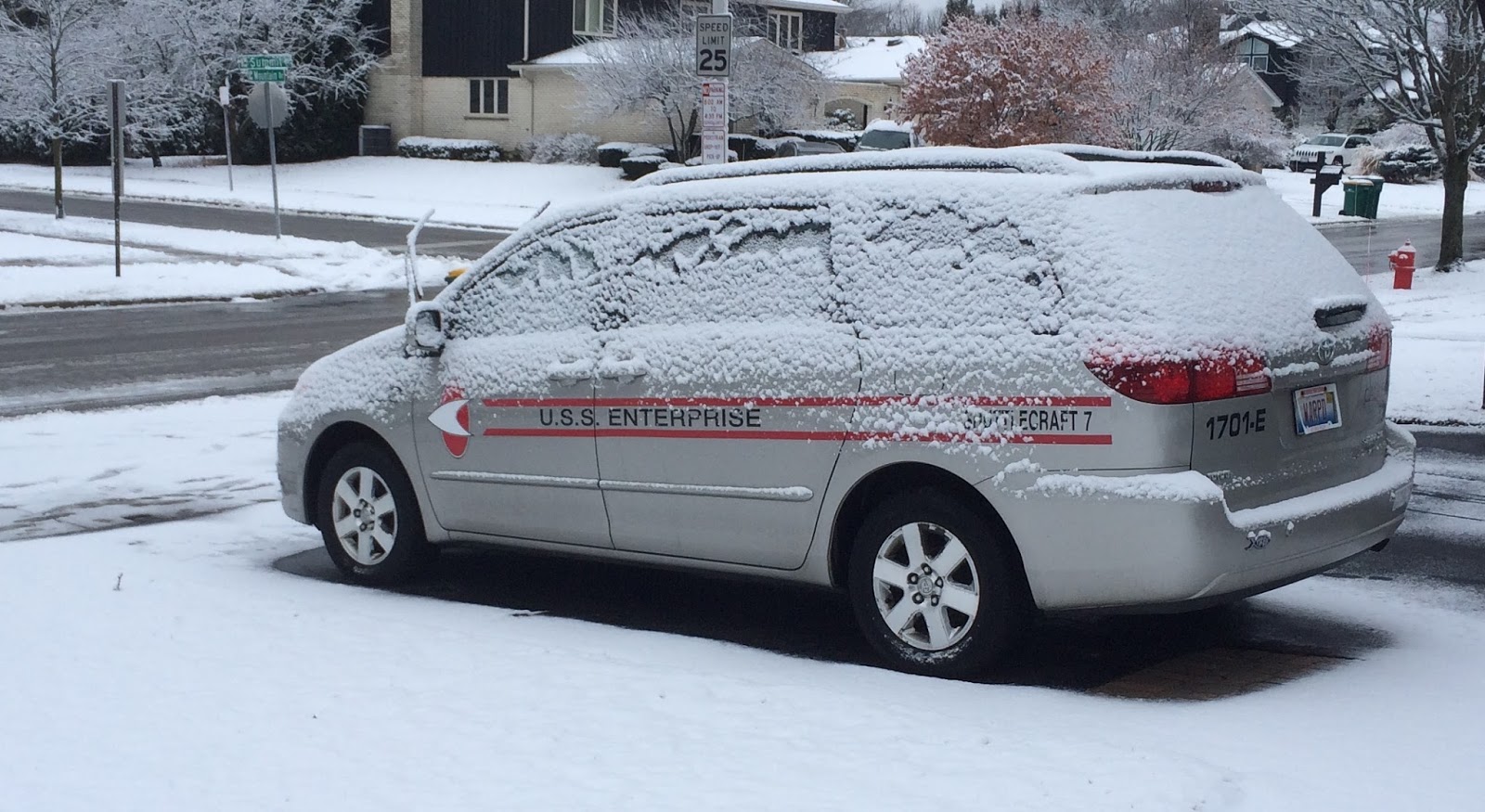
Van...Gone


I was relieved and embarrassed when I confessed to some friends that I felt very sad when I sold my minivan. It is a thing, not a person. Why would I get choked up when I turned over the keys, took off the license plates, and created an open spot in the driveway? I have never been bothered by getting rid of a vehicle before.

The van’s presence on the driveway was a sign of the development of our family. As my kids went to college and left the house, the van represented a time when we were together more often. We were busy, and we were all in that van.

I was also relieved because several friends said that they, too, grieved when they ended their relationships with their vans. Their vans represented the same things to them. They had shuttled their kids, took road trips, and journeyed to summer camps. For many of us, our vans were as old or older than our children. We had all grown up in the van!

But my van was different. My van was a Star Trek shuttlecraft. It was one of a kind, down to the double entendre license plate. It became an extension of my identity in a way. In retrospect, I wonder if that was healthy.

I was always shocked that my students knew about the van because I didn’t drive it to school! It didn’t matter. People in the community knew the van and recognized it. Weekly, I would run into someone in a store who would say some variation on, “I was looking for you. I saw the van in the lot, so I knew you were here.”

It was fun, funny, and sometimes odd when we came outside and found someone photographing the van. Everyone in the family could return a Vulcan salute from a passing vehicle on the highway. The van made people smile. It was a fun way to travel.

When I turned fifty years old, I bought a car; the van lost its spot in the garage and moved to the driveway. It became the “extra” car the kids drove or was used for special occasions. But it was still there. More than that, it was even more public since it was now in front of the house.

My children called it the “nerdmobile.” My brother thought kids at school would make fun of my children because of it. If that happened, I never heard about it. In fact, the kids had a sweet fondness for the van. It was a kind of member of the family. It was like a symbol of both my fatherhood and fandom. It was our presence on the road.

And now it is gone.

I procrastinated in both preparing to sell it and then actually making the sale. Logically, it was time. It needed repairs that we could not justify given how infrequently it was used.

But vans don’t live on logic alone.

I created an ad and, when no fans stepped forward to purchase it, I decided to make the break quick and clean and sold it to Carmax. On the way home, I was wondering if I had made the right choice. My wife had an evening meeting and I moped and grieved the rest of the night, alone in the house.

Just to be clear: my current car has no decorations. I have no plans for another Star Trek vehicle. I moved some pieces of the van into my car. I will eventually put its plates on the wall of the garage.

I wasn’t certain that I could – or should – write about selling the van. It felt silly and trivial. I was relieved and grateful when others shared their stories. It was heartening and reassuring when I posted about the van’s sale on Facebook and people understood what I was feeling.

It is odd to come home to an empty driveway. It is odd to come home to a house with no children. I am very slowly getting used to both. I will miss the van and all it represents. More than that, I miss the people it shuttled and schlepped.

Saturday, September 23, 2017

Star Trek: The Next Generation Turns Thirty!

Earthdate: September 28, 1987. Time 7pm: It was the final dress rehearsal of the student variety show. We had been working for five and half weeks and I was desperately trying to help my student create less of a gong show and more of a musical Saturday Night Live.

Things were chaotic. The show was filled with students who had never been on stage before. My college best friend had just started as my technical director and was finding her footing. We were preparing for an audience that behaved more like they were at a football game than watching theatre.

It was not a good night for the premiere of the first new Star Trek TV series in more than twenty years. Nonetheless, I borrowed my father’s portable TV with a six-inch pop-up screen pop, which weighed about twenty pounds.  I plugged it in a hallway just off the stage and watched when I could.

Of course, I was videotaping that first show, “Encounter at Farpoint,” at home! However, I could not wait that long. I had to see the show immediately! I had been waiting far too long for this.

I had been introduced to Star Trek in Sunday school (yes, Sunday school) in 1975 and I was hooked. I had watched all the original series shows so many times that I had the dialogue memorized. I had seen the films multiple times. I had copies of the animated episodes, countless novels, books, and lots of toys and paraphernalia decorated the condominium that I had purchased the prior summer, after completing my first year of teaching. It is not an exaggeration to say that Star Trek was a religious experience for me.

I caught snippets of the first episode as I ran from the theater to the costume shop to the green room to our classroom. I was dumbstruck when an elderly Dr. McCoy made a cameo. I was transfixed when we finally got to see an Enterprise saucer section separate from the secondary hull!

The rehearsal finished and the kids left around 10pm. I didn’t get out until nearly 11:30 or so. I went home and watched the episode. I stopped the tape and went back. I nearly kissed the screen trying to see all the details.

Fortunately, Star Trek: The Next Generation ran on channel 50 twice a week. I watched both times. On the first showing, I taped the show and sometimes watched along. On the second one, I watched with remote in hand and would pause out the commercials. Thus I had two sets of videotapes on which I reverently recorded all the episodes for the next seven years. 

My wife jokes that we could not go on a date until we had finished watching Star Trek. That is true. She learned all about Star Trek as we dated during the second and third seasons. No, we did not have a Star Trek wedding.

Although I had grown up with Kirk, Spock, McCoy, Uhura, Sulu, Scotty, and Chekov, it was the new cast of characters who became my icons. Star Trek: The Next Generation was a worthy successor to the original series. In more ways than I can explain here, it took the philosophy of the original and boldly went where 1960s television could never go.

It was not perfect. I worried about a captain who immediately surrendered, a counselor whose lines always seemed to be “pain, pain, anguish, anguish,” a Klingon on the bridge, and a child at the helm. The series took time to find its direction and soul, but when it did, it was one of the most rewarding and wonderful science fiction stories ever told.

Star Trek: The Next Generation came of its own as I was doing the same thing. The first few years of the series were my first years as a young teacher. As the show hit its stride in the third season, I had found my wonderful wife, married, and moved out of the bachelor condominium and into a little house. Our daughter was born at the end of the final seventh season.

The Next Generation took on big questions and told bold and ambitious stories. It wrestled with its creator’s rules and learned how to break some of them. While some episodes felt like retreads and others like they were written by a large and discordant committee, I often watched episodes several times because they were so powerful and well crafted.

The show holds up well today. I have used episodes in my own teaching, both in day school and in my Sunday school class! The issues that Star Trek continues to address retain their relevance.

It is appropriate that a new journey, a new ship, and new characters will premiere as we celebrate this anniversary. I am awaiting the new series with similar anticipation, optimism, and fear that I had way back in 1987.
Happy thirtieth birthday, Next Generation!  Here’s looking to the ongoing voyage, continuing mission, and the never-ending exploration of new worlds and new civilizations! Bring on Discovery, let’s boldly go!