Saturday, May 26, 2018

Little Camera is Watching

Recently, I purchase a dash-cam. I bought it because I had several near accidents with vehicles running red lights and stop signs, and because I was curious – and because it was on sale. It was easy to install and I have only twice looked at any of the videos that it has recorded. For the most part, I forget about it while I am driving. I remember it, however, when I see poor driving.

I think about how my driving is being captured on other people’s dash-cams. While this has changed my driving and, for the most part, I consider myself a conservative and safe driver, I wonder if people would drive differently if they thought that recordings of their driving might turn up online, at the police department, or in other ways. Would some of us slow down?  Would some of us put on a show?

Google introduced Google Glass in 2013 and more recently Google Clip. Both are, for lack of a better term, person cams. They serve the same basic function as my dash-cam, but for human beings. They are a civilian version of the body cams that some police wear.

As you move through your day, people with whom you interact might be recording everything you do and say. The ubiquity of cell phones has that potential as well. Does that change anything?

Let’s try a thought experiment: what if people at your work were recording you? What if, as you dealt with co-workers, clients, customers, and others, someone was secretly recording? How would that affect you? Would it change your behavior?

There are two questions here: one is obvious: how would the chance of being recorded affect one’s behavior? The second is what happens to that recording?

We act differently when there is a camera watching us. Our awareness that our actions will be seen by others, be more “permanent, ” and perhaps be critiqued makes us self-conscious. Our audience changes from known to unknown.

In the world of George Orwell’s 1984, Big Brother looked into the lives of his citizens through a kind of television set. Privacy was almost impossible. The state watched, judged, and punished. While we have no centralized eye in the sky, the idea that an audience is viewing what you are doing in your car, job, or anywhere is unnerving and increasingly likely.

The obvious retort is that, if you have nothing to hide, what is the big deal? Who cares if my actions go viral on Twitter? While there is value in this debate, it is moot. Video of people from cameras meant for security and all manner of personal cams are now out there. It doesn’t matter if you are behaving well or not. The world may see you and that, by itself may be a punishment.

Because the audience may not have context for your actions. The world may not know what your co-worker said to you just a few minutes before you lost your temper. The world may not see the crying person just off the screen. The world may only see the bad lane change, but may not the sick child in the backseat.

Pulling out your cell phone to record an incident is a way to both deescalate and intensify a situation. If you are going to cut in line, I am going to record you doing it and post it. You parked badly; I am going to shame you online. Just like in 1984, fear and shaming do not make a caring community. They do keep people in line.

So how do we deal with the proliferation of cameras and the recordings they produce? First, we increase our civility in public. There is nothing wrong with that. Beating people is wrong regardless of context. Second, we increase our awareness of the presence of cameras. We point them out and notice them wherever we are. If we are being watched, we should be aware of it. Third, we ask questions. Why are cameras here? Who sees the recordings? What is done with those recordings? Who has access to them and for what purposes? We add context wherever possible. If a camera appears, I may need to explain what is going on in more detail. I may need to directly address the camera. I need to think about my new audiences.

I never want to be on a reality TV show, but now we all may have our fifteen minutes of shame and blame. The camera genie is not going back into the bottle. But we must remember that the view into the bottle is often incomplete.

Saturday, May 19, 2018

Summer Science Fiction Reading and Viewing - Part 1

I taught a science fiction English class for the first time this year. This Monday is the last day. A student asked for recommendations for reading over the summer. I pointed back to our list of literature that includes more than thirty novels. Yet, there are plenty of novels that did not make that list because they were too long or felt inappropriate for use in class.

On the second to last day, my co-teacher and I asked our science fiction students to give us feedback by filling out a form. One student asked about Star Trek. This student thought since I am such a big fan, that there would have been a Star Trek unit.

I struggle saying goodbye to my seniors. I feel like anything I say is inadequate. And while I invite them to return for a visit, connect to me on social media to stay in touch, and to email me with updates, I fear that, when they walk across the stage at Ravinia, that will be the end of the story. And that makes me sad.

There are only a few things I treasure more than the gift of a good book (or movie or television show). So, for my almost former students, my actual former students, and for anyone else who is interested, here are some ideas for some science fiction summer and future reading and viewing. Beyond the joy of our relationship and time together, I can think of nothing better I can give you:

Consider reading the works that have been nominated for the Hugo award. The Hugo awards are open to anyone who participates in the World Science Fiction Convention. These novels, stories, and other works were all published or released last year. There are novels, stories of various lengths, non-fiction, artwork, television shows, and movies. If you like this list, look at past finalists and winners, too! Similarly, the Science Fiction and Fantasy Writers of America has its own awards called the Nebulas. Professional science fiction and fantasy writers select these awards. You’ll see there is some overlap between the two lists.

There are some titles on the class list that students have loved, and if you haven’t yet read, you might enjoy. I am not going to summarize or sell each book. I will leave it up to you to do a little research. Ready Player One by Ernest Cline was a big hit this year. Several students have suggested that it become required reading. Every group that read Fifth Season by N.K. Jemison loved it.

A few years ago, I made some lists of books that I love. Some titles from that group that we couldn’t put on the list for the course that you might enjoy include Stranger in a Strange Land by Robert Heinlein, Hyperion  (and The Fall of Hyperion) by Dan Simmons, Ancillary Justice by Anne Leckie, and American Gods by Neil Gaiman.

Going beyond the lists, here are a few more titles to consider:
Dune by Frank Herbert (give it at least 250 pages – be patient!)
Contact by Carl Sagen
Redshirts or Lock-In by John Scalzi
Lathe of Heaven by Ursula Le Guin
Bellwether by Connie Willis
The Princess Bride by William Goldman
The Dragonriders of Pern series by Anne McCaffery

Remember, short stories work, too! I love the collection Welcome to the Monkey House by Kurt Vonnegut Jr. Ray Bradbury has several collections including Illustrated Man, I Sing the Body Electric and The Martian Chronicles. The Locus reading list even links directly to many pieces of short fiction!

Yes, I know that my recommendations could be more diverse and I am working on this. Stay tuned.

Speaking of tuned, here are a few movies you might want to add to your summer viewing:

2001: A Space Odyssey
The Adventures of Buckaroo Banzai Across the Eighth Dimension
Arrival
Brazil
Galaxy Quest
Gattaca
Mad Max: Fury Road
The Nightmare Before Christmas
The Princess Bride
Raiders of the Lost Ark
Star Wars (the original)
Sleeper

Finally, if you want to know what Star Trek is all about, here is a list of episodes and movies to view that will give you an idea of why I love it so much.

Begin with episodes from the original series:

"Where No Man Has Gone Before"
“Balance of Terror,"
"Shore Leave,"
"Devil in the Dark,"
"City on the Edge of Forever."

Look at a few of the films:
Star Trek II: The Wrath of Kahn
Star Trek III: The Search for Spock
Star Trek IV: The Voyage Home

Then you are ready to move into the other series, which I will include in a future post like this.

I also strongly recommend The Final Reflection by John Ford. It is a Star Trek book, and it is outstanding science fiction. It is worthwhile even if you are not a Star Trek reader.

I know this collection leaves out very important novels, movies, and television series. It is woefully incomplete, thus the “part 1” in the title. The most important thing is to keep exploring: books, movies, graphic novels, and anything else – and then share them!


Saturday, April 21, 2018

Death of a Website

In the summer of 2000, I took a workshop on creating websites. We used Front Page, a program that didn’t make us code directly in HTML, and made it easy to create simple web pages. I was hooked. I created an elaborate teacher website that looked like the computer interface from Star Trek: The Next Generation.

At first, my website was a simple way for students and others to get the handouts that we used in class. I linked the homework calendars, syllabuses, specific assignment sheets, and handouts in HTML form.

Then I realized that I could do far more. I created an FAQ page to address the many parent questions that I had fielded for decades. I took many useful handouts, from grammar and writing to study strategies, research, and public speaking, and put them in a special resources section of the website. I posted my schedule in great detail so students would find it easier to make appointments with me or get in touch.

I speak at several school presentations throughout the year. I talk to seniors and their parents about college essays and freshman parents about responding to progress notices. I took these presentations, my notes on them, and related information and created web pages for them. A few years later, I recorded all of Charles Dicken’s A Tale of Two Cities with explanations and annotations. I posted them on my website.

In short, I put my teacher life on the web for all to see.

Students were not yet carrying around computers during this time. Neither the Chromebook nor the iPad had been released and portable computers were very expensive. However, we had desktop computers throughout the school, and almost every student had access to one at home. Handwritten assignments were becoming rare, and most students produced their work on computer.

I suppose you could call this era Web 1.0. When we started to use tools like turnitin.com, a server to which students upload their work that checks for plagiarism and allows for digital feedback, I needed to make some significant updates to my website. I incorporated Google products into it.  I gave it a makeover.

By this point, my website had several thousand pages, most of which were always accessible. In about fifteen years, I had fully integrated this website and its online resources into the fabric of my teaching.

In the summer of 2015, our district updated its website, and all of a sudden, I could not get to my website and make changes. I called the person in charge and was told that my website had been “legacied.” I almost threw up. I thought I might cry. I explained that this was not a little three-page site with my phone number and email address; it was an integral part of my teaching! I begged not to have it taken away!
 

I was heard. My website was “migrated.” I continued to change the quotation on the front page weekly. I updated it so it had everything students, parents, case managers, and others would need.

After we distributed Chromebooks and kids brought their individual devices to school, the website became a digital blackboard, a powerful way to extend the classroom beyond the walls of the school.

My district is now going to use a learning management system called Schoology next year and it will work as well or better than my old website. Schoology will be one-stop shopping for all learning materials, grades, and school information. It will be better than my old website.

So I am about to voluntarily close it. No one is making me. It is time. It has lived its life and now there are tools that will function more effectively. Mr. Hirsch’s Online Classroom will close after almost eighteen years of service. That’s a long run for technology in the twenty-first century. I don’t know if the old site will still be accessible, but I don’t think that anyone will miss it. It lasted longer than any of my computers.

Who knows how future children will access school information and on what devices? Perhaps I hung on to the old website too long. My goal is always to help develop independent and self-directed learners. My old website helped me do this. I am hopeful that the new system will do this even better. At the end of this school year, my website will truly be officially retired. It is sad, but it is time.

Saturday, April 7, 2018

A Rubric For Thank You Notes

Dear Hirschs, Thank you for the generous gift. It was nice to see you. From, X.

Is that a thank you note? What does that really communicate? That note has only a shred of gratitude. It says that we didn’t merit much energy or care. Its message is almost the opposite of the words. I don’t think that is what the writer intended. The writer didn’t intend anything, but the writer wasn’t that thankful and it shows.

There are two issues here: the first (and more important of the two) is that the idea that thanks are necessary. The second is that they are communicated sincerely. Children’s thank you notes are a learning opportunity. When children send thank you cards after receiving birthday, holiday, bar or bat mitzvah or other special gifts, they are getting out of themselves. They are thinking about the feelings and point of view of another. This is a critical developmental task that, if not accomplished, will handicap their relationships for life. Perhaps if we had more thank you notes, we’d have fewer narcissistic people.

However, I must point out that many adults either neglect the thank you note or write them poorly. Therefore, here is the Hirsch family thank you note rubric. This is our thank you note measuring stick. Thank you notes tell a great deal about both the sender and the nature of the relationship.

A good thank you note is personal. If the wrong name came after the “Dear,” it would make no sense. If the name is misspelled, that has a message, too. The note speaks of the relationship between the sender and receiver. Even if that relationship is new or indirect, it addresses that. So notes may say, “It was so nice to see my parents’ good friends,” or  “It was wonderful to share our wedding with my new friends from work.” Sometimes, you are acting as an agent for another person. Your thank you note is no longer about you; it is about the giver’s connection to your parents, employers, or spouse. The specific relationship is the core of the note. It is more important than the item that generated it.

A good thank you note is specific. It says, very directly, why the writer is thankful, “Thank you for the beautiful vase,” or “ I love books and I will think of you as I use the gift card.” Even if the gift was money or intangible, it should still be mentioned, “I will put the check to good use,” or  “It was so kind of you to let me stay overnight.”

A good thank you note has some degree of detail. It is not generic. The typical formula says that you should mention how you will use the gift or why it is important to you. That is sound advice. There are other options too, “I loved playing with your dogs while I stayed with you,” or “The frame reminds me of one I always loved in Aunt Sadel’s apartment.”

Of course, a good thank you note is timely. People quote all sorts of rules about how long you have before a thank you note is too late. I have even heard that wedding couples have a year to send the notes. A year? Really? What would you think if you received a thank you note twelve months after the wedding? You probably sent the gift a month or more before the wedding anyway. I wouldn’t remember what I gave!

A late thank you note says that saying thanks wasn’t a priority to the writer. By extension, it feels like the relationship is also not that important. A good thank you note should reflect the care and effort put into the gift.

Which brings us to the question of how to send a thank you note for awful or thoughtless gifts. If it is really the thought that counts, then these gifts barely qualify. So what is wrong with sending, as my old college professor used to say, a  “thank you and %@#$ you” card? A lot. We answer kindness with kindness but I would want to give the other person the benefit of the doubt and answer thoughtlessness with thoughtfulness. The card need not be long, but it should be as sincere as possible. It should not be sarcastic or critical. If there are problems with the relationship, the thank you note is not the way to address them.   

My grandmother was the only person who ever wrote thank you notes for thank you notes. I remember asking my father, “Do I need to send her a thank you for the thank you for my thank you?” Of course, he told me to just call my grandmother. Always a good idea.  

But her intention captures the real importance of the thank you note – or even the thank you email: gratitude and connection. A thank you note should be a sincere expression, not only of thanks, but also of the connection between the person writing and the person receiving.  It says, “You showed that you care. I appreciate that and I value our relationship.”

Tuesday, March 20, 2018

Mixed Up Lines

A few years ago, when my daughter came home from school, she stormed over to me and said, “I am so angry with you!” This didn’t happen often, so I was concerned. “You have ruined me!” she told me.

She explained that in class someone had said, “You can lead a horse to water…” and my daughter had added, “but you can’t make it swim.” The room broke out in laughter and she didn’t understand why.

I did. You probably do. I understood why she was upset with me.  Oops.

Similarly, if I accidentally rhyme in class, I say that “I’m a poet and I’m not consciously aware of that fact.” This wouldn’t get my daughter in trouble – I think.

I love to play with words, phrases, letters, and language. I don’t say the proverb the regular way; I mess around with it. I can’t remember the last time I talked about that horse drinking. My daughter had only heard my riff on the original. Now she knows.

I am constantly mixing up language in class. My speech is peppered with spoonerisms. Spoonerisms are the mixing up of the initial constant sounds of a phrase or sentence. My students know exactly what I want them to do if I tell them to go sack to your beats. Taking a cue from the wonderful lirty dies of Capitol Steps, I often address them as Jadies and Lentleman. My Freshman English students play the Punday Suzzle, and homeroom says the ledge of pallegiance every day. 

One year, my Senior English class surprised me with a special gift at the end of the year. It was a long, large, and flat wrapped package. When I opened it, I couldn’t contain my laughter. It was a pair of pruning cutters. Yes, it was a gift of shears. "Gifting shears" is my frequent transition statement – another spoonerism.

Of course, I love puns! I tell kids that I am very impatient: I have a wait problem. I encourage them to imitate Shakespeare and punish each other by being bad to the bard. As we open our computers (or notebooks) to journal or start an essay, I tell students to “do the write thing!” If they don’t start fast enough, I tell them to “write away” or to do it “write now!” Yes, sometimes my puns get a groan. That is second place to a laugh, but I’ll take it.

Of course, there are always students who finish the writing too quickly. They set aside their pens or machines and look at me and say that they are done. I shake my head and tell them that they are still rare, maybe medium rare or medium, but they are certainly not done, and I want their work to be well done!

Then one will ask if it is okay that they finish anyway. I have perfected the art of saying “no” but shaking my head up and down. As you would expect, this is confusing. My non-verbal communication is saying one thing and my voice is saying the opposite. “Which is it?” They ask. Yes, that is the question.

When discussing certain literary elements, I always pretend that I am the percussionist at the back of the band and have crashed my two big pieces of metal together.  When we start to decode those eyes in Gatsby or the sea in A Tale of Two Cities, students also get the pun cymbal and symbol.

My former student Aaron (and several others) reminded me that, when I would check for understanding, I would ask in my very very bad Italian: “Catfish?” Similarly, Lucas reminded me that my French is as poor as my Italian. While we may say, “please” in English, I frequently thank students with “mercy buckets.”

-->
Language is not static. I encourage kids to play with language. As we write and speak, we must think about not just what we are saying, but the words we use. Language forms the foundation of our thought. Changing our words can change our perception. Language matters. Words matters. I hope my mixed up word playfulness gives kids permission to play along!  

Saturday, March 10, 2018

Van...Gone


I was relieved and embarrassed when I confessed to some friends that I felt very sad when I sold my minivan. It is a thing, not a person. Why would I get choked up when I turned over the keys, took off the license plates, and created an open spot in the driveway? I have never been bothered by getting rid of a vehicle before.

The van’s presence on the driveway was a sign of the development of our family. As my kids went to college and left the house, the van represented a time when we were together more often. We were busy, and we were all in that van.

I was also relieved because several friends said that they, too, grieved when they ended their relationships with their vans. Their vans represented the same things to them. They had shuttled their kids, took road trips, and journeyed to summer camps. For many of us, our vans were as old or older than our children. We had all grown up in the van!

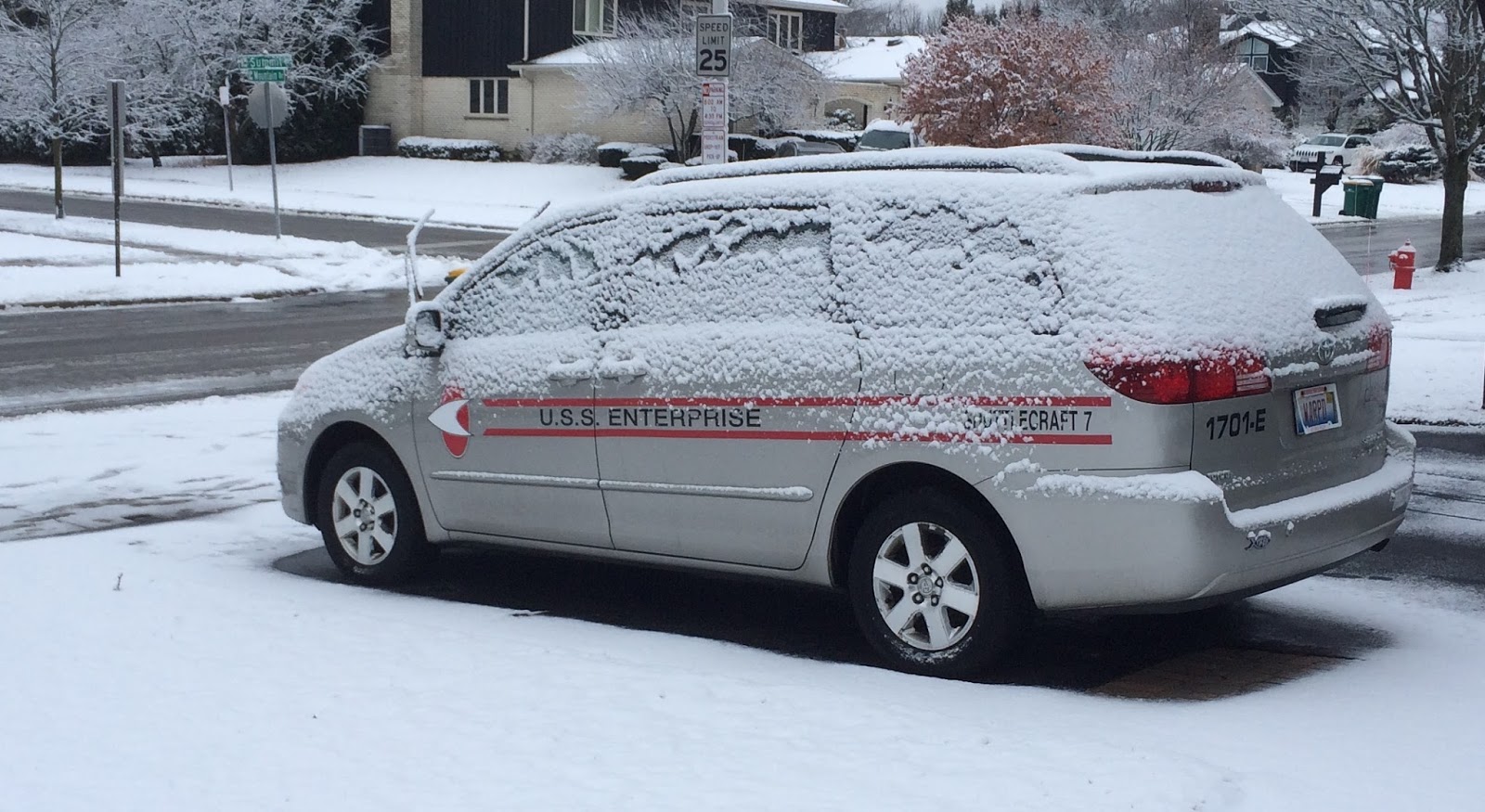
But my van was different. My van was a Star Trek shuttlecraft. It was one of a kind, down to the double entendre license plate. It became an extension of my identity in a way. In retrospect, I wonder if that was healthy.

I was always shocked that my students knew about the van because I didn’t drive it to school! It didn’t matter. People in the community knew the van and recognized it. Weekly, I would run into someone in a store who would say some variation on, “I was looking for you. I saw the van in the lot, so I knew you were here.”

It was fun, funny, and sometimes odd when we came outside and found someone photographing the van. Everyone in the family could return a Vulcan salute from a passing vehicle on the highway. The van made people smile. It was a fun way to travel.

When I turned fifty years old, I bought a car; the van lost its spot in the garage and moved to the driveway. It became the “extra” car the kids drove or was used for special occasions. But it was still there. More than that, it was even more public since it was now in front of the house.

My children called it the “nerdmobile.” My brother thought kids at school would make fun of my children because of it. If that happened, I never heard about it. In fact, the kids had a sweet fondness for the van. It was a kind of member of the family. It was like a symbol of both my fatherhood and fandom. It was our presence on the road.

And now it is gone.

I procrastinated in both preparing to sell it and then actually making the sale. Logically, it was time. It needed repairs that we could not justify given how infrequently it was used.

But vans don’t live on logic alone.

I created an ad and, when no fans stepped forward to purchase it, I decided to make the break quick and clean and sold it to Carmax. On the way home, I was wondering if I had made the right choice. My wife had an evening meeting and I moped and grieved the rest of the night, alone in the house.

Just to be clear: my current car has no decorations. I have no plans for another Star Trek vehicle. I moved some pieces of the van into my car. I will eventually put its plates on the wall of the garage.

I wasn’t certain that I could – or should – write about selling the van. It felt silly and trivial. I was relieved and grateful when others shared their stories. It was heartening and reassuring when I posted about the van’s sale on Facebook and people understood what I was feeling.

It is odd to come home to an empty driveway. It is odd to come home to a house with no children. I am very slowly getting used to both. I will miss the van and all it represents. More than that, I miss the people it shuttled and schlepped.